Spatial modules
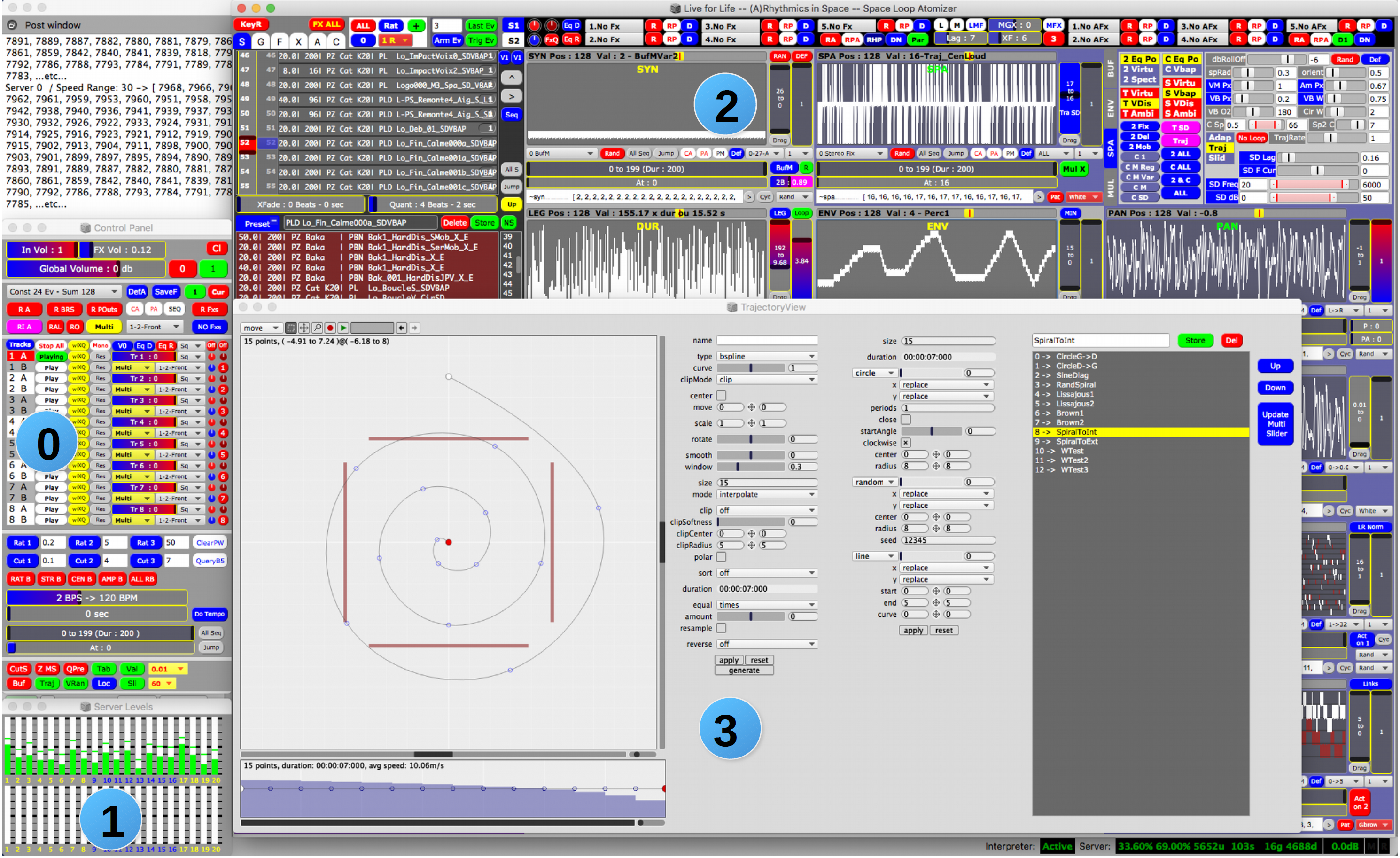
Screen view representing different windows of the spatial tool :
- 0 : Control panel.
- 1 : Level indicators showing the volume of 16 loudspeakers for the first server above and second server below.
- 2 : Sequence view with parameter modules of 200 values or sound events.
- 3 : 2D trajectory library editor built from the WFSCollider editor (https://github.com/GameOfLife/WFSCollider-Class-Library). The trajectory editor can be opened with
Trajbutton, which is above the RTM module (if you do not see it, click on the [GEN (in red) / RTM (in blue)] button at the top right of the view above the RTM module, to change the view between rhythmic and more general controls).
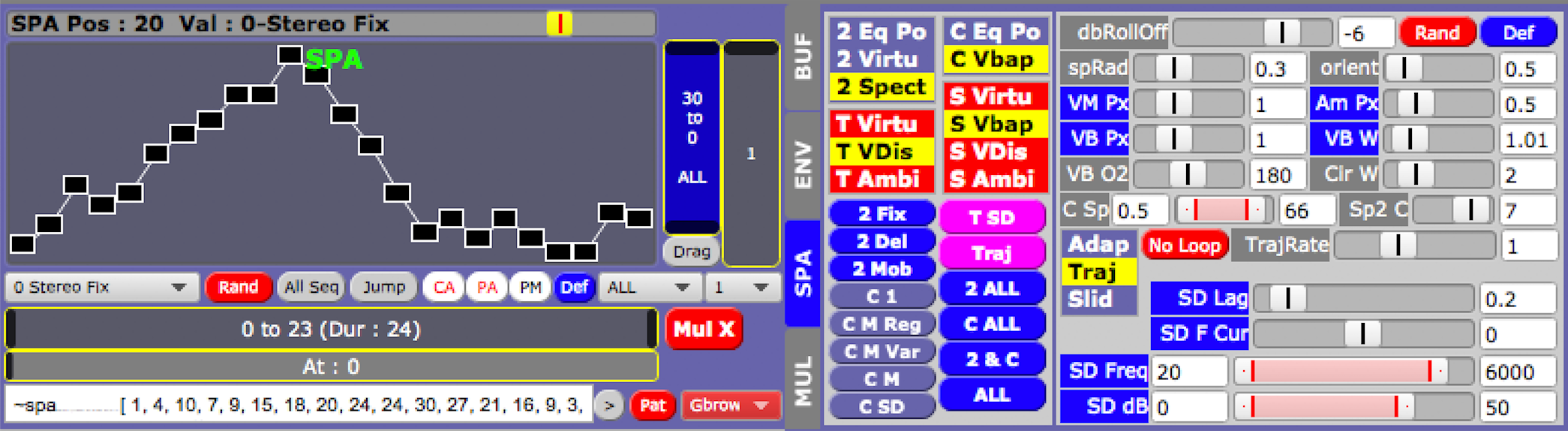
- Spatial module n°12 on the left, to define the position or trajectory of each sound event in the sequence
- Spatial module n°13 on the right, to define spatial algorithms and arguments of the spatial trajectories of the sequence
SPA spatialisation modules allow to choose for each sound event between all kinds of spatial algorithms (channel-based or object-based paradigms : concrete position of the speaker or abstract position in space). As Monica Bolles (2019) says, “choosing between spatialization algorithms is like choosing between different microphones. They each have their own sound and their use is highly dependent on the experience and tone you are trying to capture and portray”. All spatialisation algorithms have their strengths and weaknesses in terms of coloration, localisation accuracy or presence – from the blurring of first-order Ambisonics to the highly localised VBAP, from presence when sending to a single speaker to the greater spread of amplitude or spectral panning between two or more loudspeakers.
SPA modules also include concrete spatialisation techniques, which make it possible to enlarge the apparent space of the source or to generate movements, such as inter-channel micro-delays, which can be of the order of 13 or 31 ms as noted by Vaggione ([1], p. 20), and/or small pitch changes, dynamic filtering ([2], 1998, p. 222), or variations in playback speeds in any of the channels. Concrete spatial techniques acting on the internal space and the parameters of each sound event are also present in these modules for certain movements (see no. 14 to 17 of table below), by linking the data of the sound analysis (e.g. spectral centroid or intensity) to a spatial dimension (e.g. azimuth, elevation, horizontal axis or rotational speed).
Several types of (de-)correlations (micro-temporal, spectral and spatial) are available. For example, spatialised sounds with a 2D trajectory can be reflected on the horizontal axis, so as to correlate movement, with a slight variation in playback speed to slightly decorrelate the spectrum, which has the effect of creating a larger spatial picture. Or, the sounds in the sequence can be copied multiple times and varied with spatio-temporal differences and playback speed variations, to create spatialised choruses of the same sound with different algorithms and spatial parameters.
Although there is a visualization of the loudspeaker levels for each of both servers (see 0 of the first figure), the trajectories being played are not displayed, not only for reasons of efficiency, but mainly for focusing on listening and changing parameters, because a visual trajectory can be misleading and is not a useful feedback on sound perception.
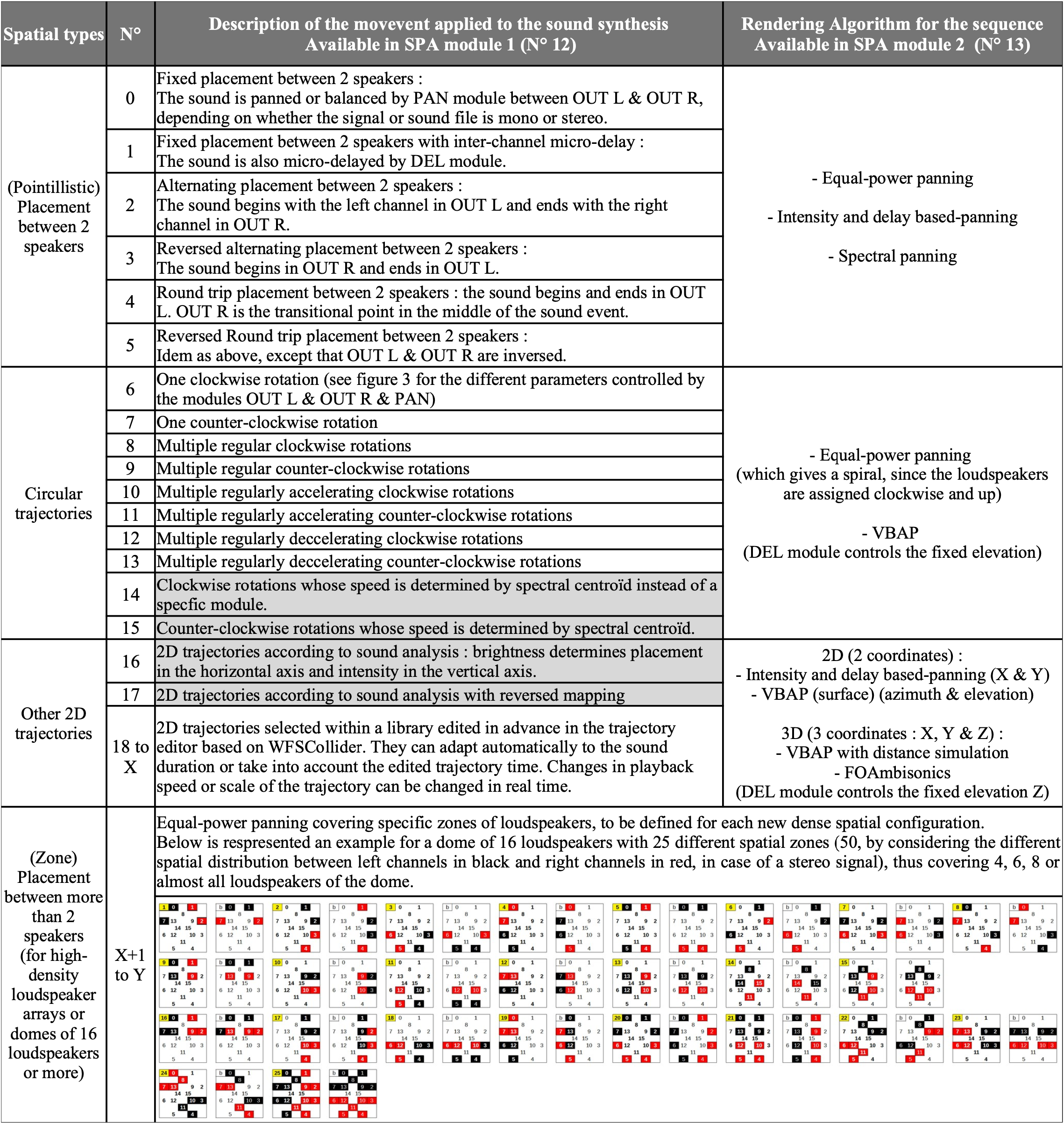
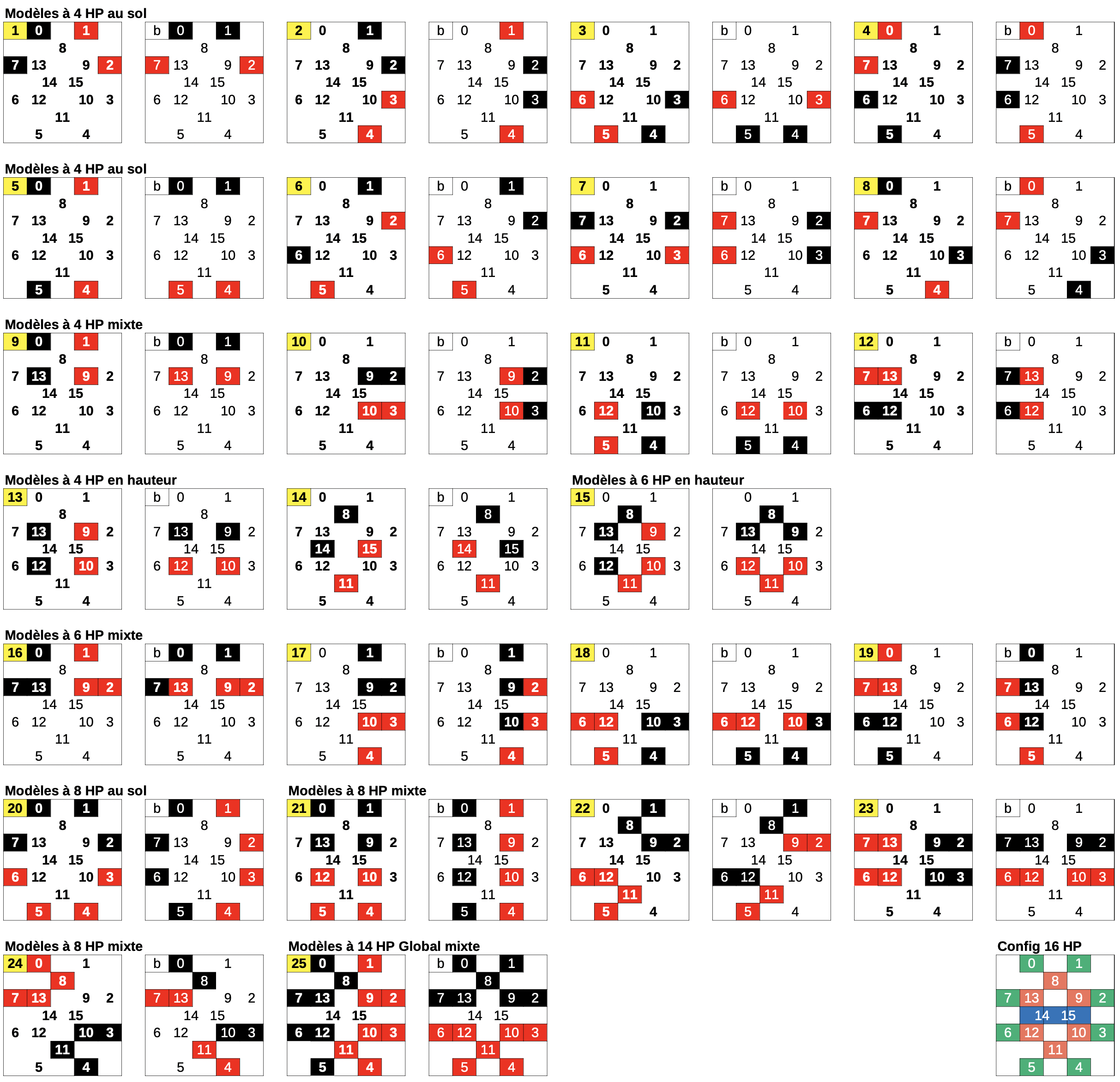
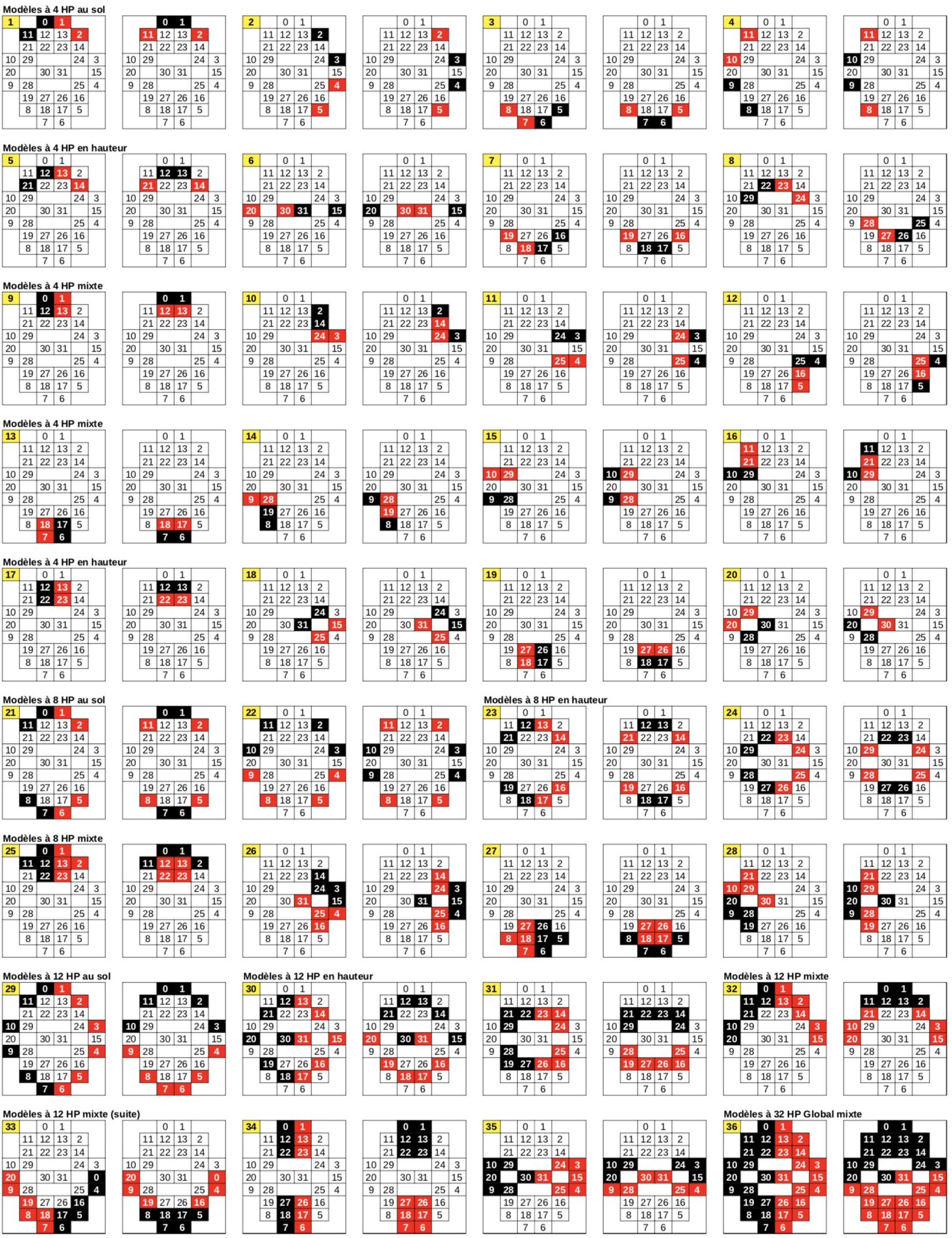 Diagram of the different zones within the framework of a spatial configuration of 32 loudspeakers, based on a representation of room B-187 at UdeM, numbered from 0 to 31. The black and red represent respectively the left and right channel.
[1] Horacio Vaggione. Décorrélation microtemporelle, morphologies et figurations spatiales du son musical. Dans Anne Sédès, éditeur, Espaces sonores, pages 17–29. Paris, France : Éditions musicales transatlantiques, 2002. Résumé repéré à http://jim.afim- asso.org/jim2002/articles/L27_Vaggione.pdf.
[2] Rainer Boesch. Composition / diffusion en électroacoustique. Dans Françoise Barrière et Gerald Bennett, éditeurs, Académie de Bourges, Actes III, Composition / Diffusion en Musique Électroacoustique, pages 39–43. Bourges, France : Éditions Mnémosyne, 1998.