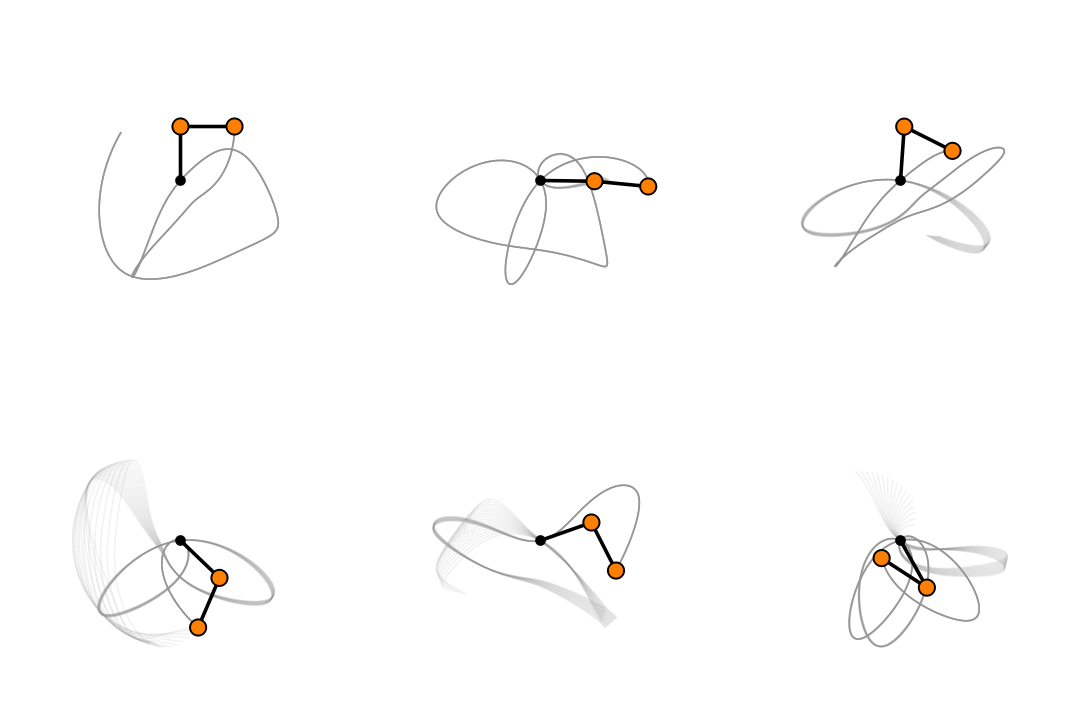

Hash functions are functions that take as input some arbitrary length of data, and outputs a fixed length hash. Among other things, professional hash functions have the attribute that a slight change in the input data results in a drastic change at the output. This behaviour is also seen in physics; the double pendulum is a system that is very sensitive to the initial parameters, and a slight change in, say, the angle of one of the pendulums might result in very different behaviour as the system evolves. As such, I thought it might be a fun idea to combine the two and create my own hash function that depends on computations of the double pendulum to produce its output.
Disclaimer:
You're welcome to do with the code as you wish but do NOT use it in any application where robustness and/or correctness is required.
The function numerically solves the pair of differential equations that emerge from the double pendulum system1.
This is done using SciPy's solve_ivp function. The initial values for the problem are generated from the input data.
This project is not a very serious exercise, thus I was not concerned with the details.
The conditions that I wanted my function to satisfy (which it more or less does) are as follows:
- Produce a fixed-length output for any arbitrary length input.
- Produce the same output for the same input.
- Have a decent collision resistance, that is, mostly produce unique hashes for unique inputs.
- Produce greatly different outputs for two slightly different inputs.
There conditions are reflected in the tests I wrote for the function.
Run: python dphf.py <your string>
See also folder dpht/ which implements a hash table using the DPHF as its hash function.
Footnotes
-
See for example this: https://www.myphysicslab.com/pendulum/double-pendulum-en.html ↩