Up2/PCM512x w/ gpiochip to control LEDs and clocks #1945
Conversation


 plbossart
requested review from
dbaluta,
kv2019i,
lgirdwood and
ranj063
as code owners
plbossart
requested review from
dbaluta,
kv2019i,
lgirdwood and
ranj063
as code owners


 plbossart
changed the title
plbossart
force-pushed
the
fix/sof-pcm512x-leds
branch
from
plbossart
changed the title
plbossart
force-pushed
the
fix/sof-pcm512x-leds
branch
from
062e787 to
8ed2d76
Compare
sound/soc/intel/boards/sof_pcm512x.c
Outdated

There was a problem hiding this comment.
We have multiple HiFiBerry models, right? Maybe an enum?

|
Good instructions, thank you! I got the "DAC+ PRO detected" to dmesg but it sounds like the sample rate is off (flat). Playing 997 Hz sine sounds as 880 Hz and playback of 10s wav clip takes 11.5s. There's traces output with "ERROR validate(), ll drift detected, delta = 20781". The sound is continuous and no xruns, and other but rate good quality as far as I can tell with my home setup (cheapo powered travel speaker only). I'm using your topology as such, no ASRC. |
|
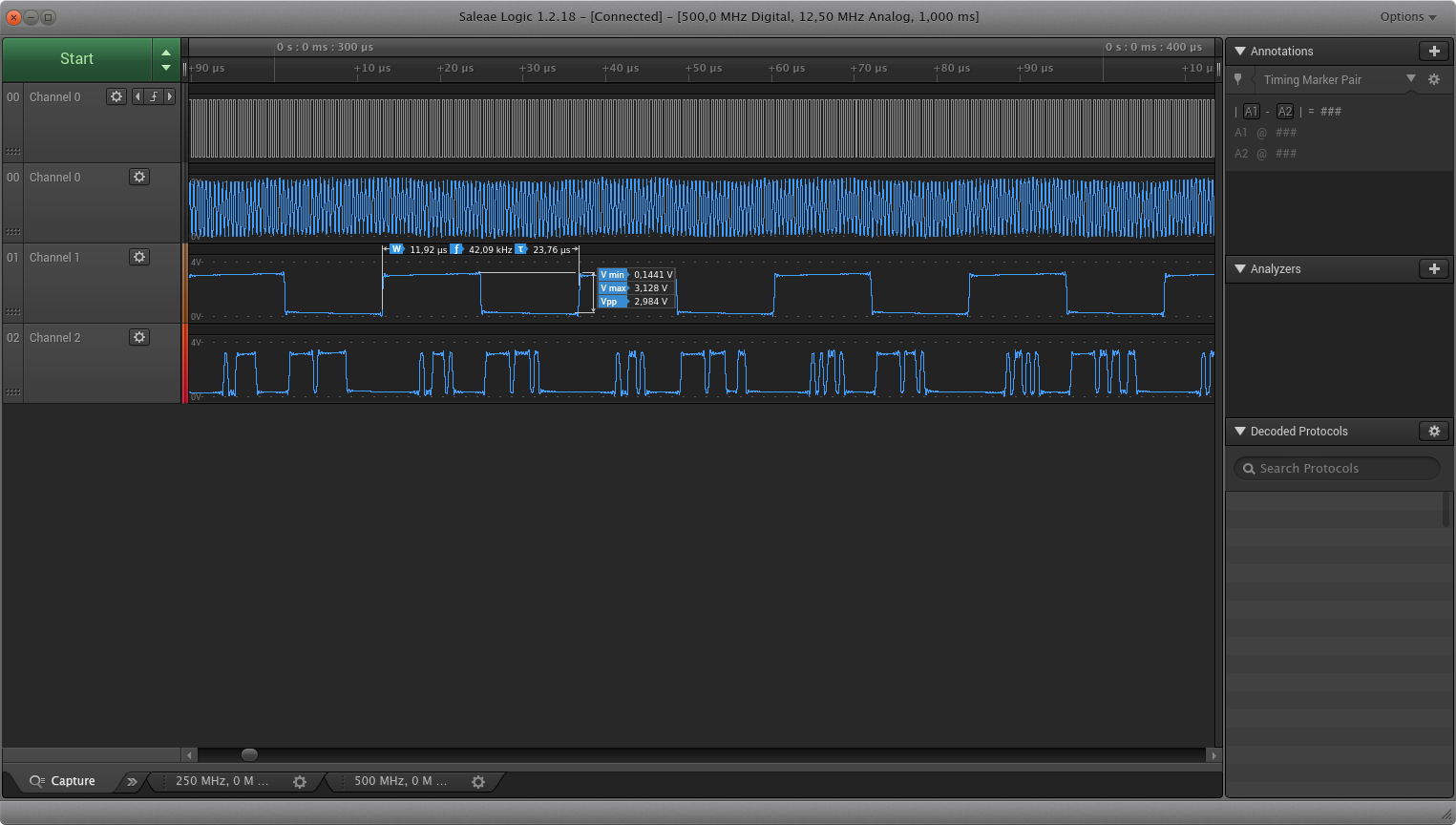
I got the oscilloscope connected. The frame sync is about 42.2 kHz. The variation is 42.1 - 42.3 kHz:
I'm not familiar with the scope SW. I'll see if I can get better picture with faster sampling. |
|
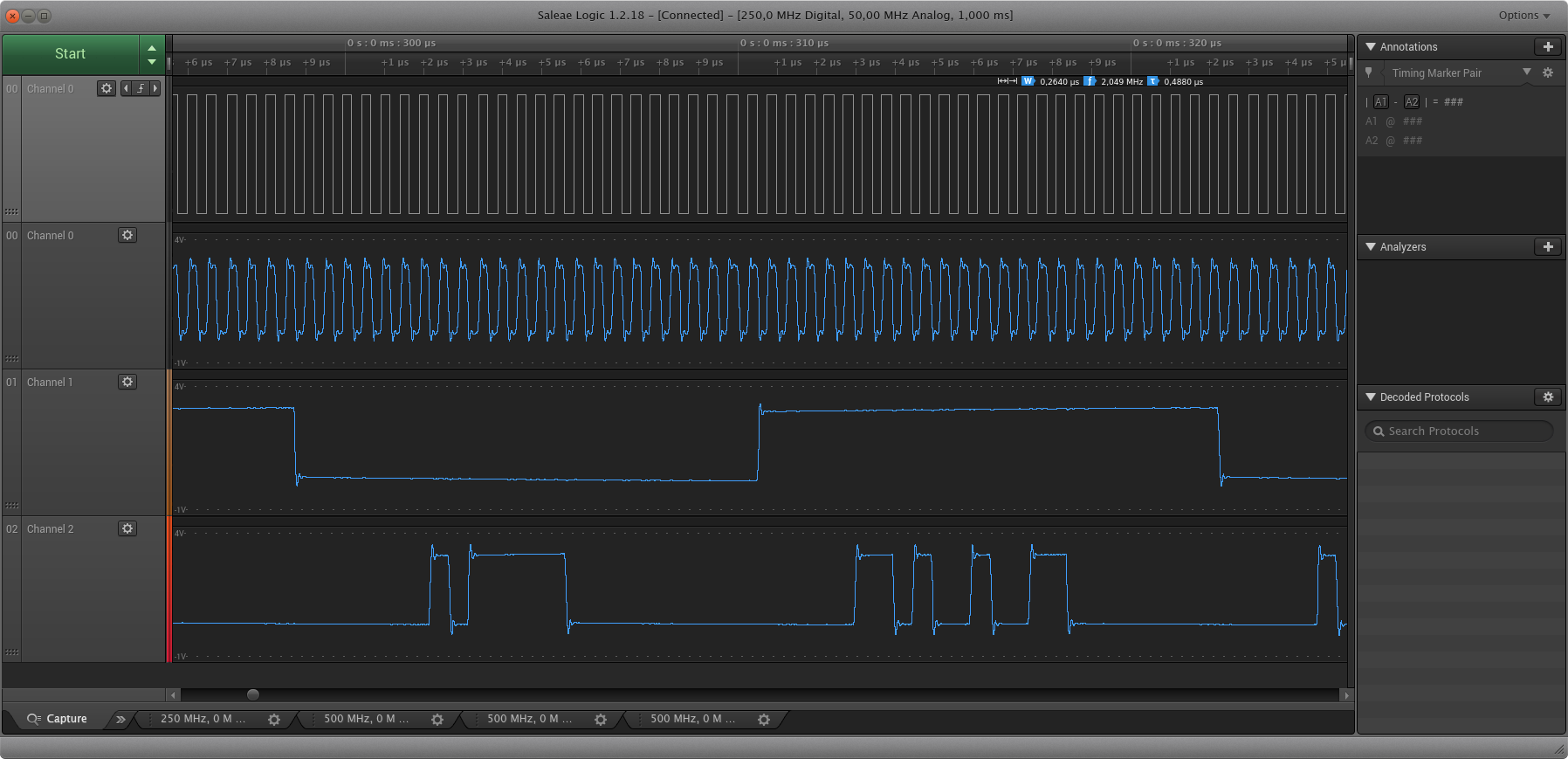
Not faster sampling but learned to zoom. The BCLK is steady 2.049 MHz.
|
|
@singalsu if the bclock is 2048kHz, it is based on 32kHz instead of 48kHz then, or we have a problem with S24 handling? Interesting. But the 997->880 Hz change would mean a 42367kHz, that's not aligned with the bclk settings. |
plbossart
force-pushed
the
fix/sof-pcm512x-leds
branch
from
8ed2d76 to
db1d01f
Compare
|
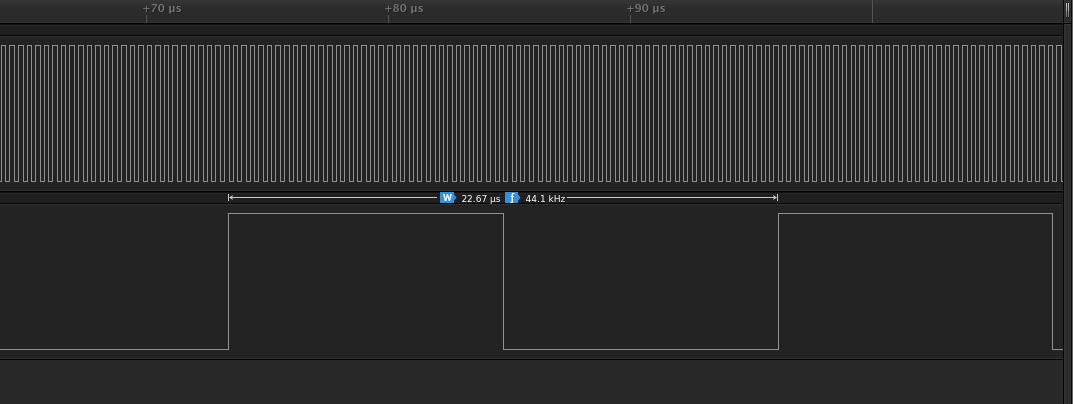
@lyakh can you recheck the code, I added most of your suggested changes. @singalsu the clock errors are corrected, and if you take in addition the update from the topology I just pushed we can support 44.1 kHz. There were two issues in my previous versions, I was taking the wrong clock and the bclk_ratio was 24 instead of 32. Note that it seems the BIOS configuration for inputs does not survive if you take the power off, I again had issues this morning.
|
|
@plbossart Great work, here the playback is now perfect as far as I can tell with the setup. I don't have issue with BIOS settings, the settings remain. Maybe your flash or battery backup (?) has got broken. Once your work is merged I'll update the UP2 test ASRC topology use this configuration. Edit: I've tested both 44.1 kHz and 48 kHz topologies. |
 plbossart
force-pushed
the
fix/sof-pcm512x-leds
branch
from
plbossart
force-pushed
the
fix/sof-pcm512x-leds
branch
from
db1d01f to
e5172b1
Compare
plbossart
force-pushed
the
fix/sof-pcm512x-leds
branch
2 times, most recently
from
167f5a7 to
fb9fcc3
Compare

The function connects an IRQ domain to a gpiochip and reuses
gpiochip_to_irq() which is provided by gpiolib.

gpiochip_irqchip_* and regmap_irq partially provide the same
functionality. This function will help to connect just the
minimal functionality of the gpiochip_irqchip which is needed to
work together with regmap-irq.

Signed-off-by: Michael Walle <michael@walle.cc>
There are quite a lot simple GPIO controller which are using regmap to
access the hardware. This driver tries to be a base to unify existing
code into one place. This won't cover everything but it should be a good
starting point.

It does not implement its own irq_chip because there is already a
generic one for regmap based devices. Instead, the irq_chip will be
instantiated in the parent driver and its irq domain will be associate
to this driver.

For now it consists of the usual registers, like set (and an optional
clear) data register, an input register and direction registers.
Out-of-the-box, it supports consecutive register mappings and mappings
where the registers have gaps between them with a linear mapping between
GPIO offset and bit position. For weirder mappings the user can register
its own .xlate().

Signed-off-by: Michael Walle <michael@walle.cc>
Add myself as a reviewer for the gpio regmap.

Signed-off-by: Michael Walle <michael@walle.cc>
plbossart
force-pushed
the
fix/sof-pcm512x-leds
branch
from
d6cb9cd to
fe8af5f
Compare
|
@singalsu can you try the update? it's the same functionality but implemented with a shiny new 'gpio-regmap' solution. |
The GPIOs are used e.g. on HifiBerry DAC+ HATs to control the LED
(GPIO3) and the choice of the 44.1 (GPIO6) or 48 (GPIO3) kHz
oscillator (when present).

Enable gpio_regmap to get/set values and get/set directions. Tested
with GPIO_LIB from sys/class/gpio, the LED turns on/off as desired.

Signed-off-by: Pierre-Louis Bossart <pierre-louis.bossart@linux.intel.com>
Using devm_clk_get() with a NULL string fails on ACPI platforms, use
the "sclk" string as a fallback.

Signed-off-by: Pierre-Louis Bossart <pierre-louis.bossart@linux.intel.com>
Remove direct regmap access, use gpios exposed by PCM512x codec
Keep the codec_init function, this will be used in following patches

The gpios handling is done with an explicit lookup table. We cannot
use ACPI-based mappings since we don't have an ACPI device for the
machine driver, and the gpiochip is created during the probe of the
PCM512x driver.

Signed-off-by: Pierre-Louis Bossart <pierre-louis.bossart@linux.intel.com>
Try to detect HifiBerry 44.1 and 48kHz oscillators on codec init

Signed-off-by: Pierre-Louis Bossart <pierre-louis.bossart@linux.intel.com>
The SCLK is resumed by the codec driver. In case the rate specified in
hw_params does not match the current configuration, disable, set the
new rate and restart the clock.

There is no operation on hw_free, the codec suspend routine will
disable/deprepare the clock.

Note that we don't change the DAI configuration when the DAC+ PRO is
detected. All changes for the codec master mode are handled in the
topology file (DAI configuration change and scheduling change)

Signed-off-by: Pierre-Louis Bossart <pierre-louis.bossart@linux.intel.com>
This configuration is needed to get the GPIO-controller clocks.

Signed-off-by: Pierre-Louis Bossart <pierre-louis.bossart@linux.intel.com>
This patch imports the clock code from the Raspberry v5.5-y tree. The
ASoC machine driver initially present in this patch was dropped. The
comments are also dropped but all sign-offs are kept below. The patch
authorship was modified with explicit permission from Daniel Matuschek
to make sure it matches the Signed-off tag.

This patch generates a lot of checkpatch.pl warnings that are
corrected in follow-up patches.

Signed-off-by: DigitalDreamtime <clive.messer@digitaldreamtime.co.uk>
Signed-off-by: Daniel Matuschek <daniel@hifiberry.com>
Signed-off-by: Matthias Reichl <hias@horus.com>
Signed-off-by: Hui Wang <hui.wang@canonical.com>
Signed-off-by: Pierre-Louis Bossart <pierre-louis.bossart@linux.intel.com>
Reformat license information and add Intel copyright

Signed-off-by: Pierre-Louis Bossart <pierre-louis.bossart@linux.intel.com>
Lots of small issues, xmas style, alignment, wrong comments, memory leak

Signed-off-by: Pierre-Louis Bossart <pierre-louis.bossart@linux.intel.com>
Make sure OF is enabled, in case ACPI platforms use OF matching with
PRP0001 and .compatible string

Signed-off-by: Pierre-Louis Bossart <pierre-louis.bossart@linux.intel.com>
devm_clk_register() and of_clk_add_provider() are deprecated, use the
recommended functions.

Signed-off-by: Pierre-Louis Bossart <pierre-louis.bossart@linux.intel.com>
On ACPI platforms the of_ functions are irrelevant, conditionally
compile them out and add devm_clk_hw_register_clkdev() call instead.

Signed-off-by: Pierre-Louis Bossart <pierre-louis.bossart@linux.intel.com>
devm_clk_get() fails on ACPI platforms when a NULL string is used.
Create a "sclk" lookup to make sure codec and machine drivers can get
the clock.

Signed-off-by: Pierre-Louis Bossart <pierre-louis.bossart@linux.intel.com>
Now that the PCM512x driver exposes GPIOs, we can set their values as
needed in this clk driver (instead of doing nothing).

This clk driver does not have access to the codec regmap, so it only
toggles GPIOs. The user (typically a machine driver) should verify
that the clocks are present by testing the PCM512x_RATE4_DET register
(reports if the sclk is seen by the codec).

Signed-off-by: Pierre-Louis Bossart <pierre-louis.bossart@linux.intel.com>
Add a delay to make sure the PCM512x codec can detect SCLK presence.

The initial code from the Raspberry tree used msleep(2), which can be
up to 20ms. A delay of 5-10ms seems fine in practice.

Signed-off-by: Pierre-Louis Bossart <pierre-louis.bossart@linux.intel.com>
The Hifiberry DAC+ PRO relies on two local audio oscillators exposed
with the clock framework.

Signed-off-by: Pierre-Louis Bossart <pierre-louis.bossart@linux.intel.com>
plbossart
force-pushed
the
fix/sof-pcm512x-leds
branch
from
fe8af5f to
4424962
Compare


|
|
||
| ctx->gpio_4 = devm_gpiod_get(&pdev->dev, "PCM512x-GPIO4", | ||
| GPIOD_OUT_LOW); | ||
|
|
| /* .dev_id set during probe */ | ||
| .table = { | ||
| GPIO_LOOKUP("pcm512x-gpio", 3, "PCM512x-GPIO4", GPIO_ACTIVE_HIGH), | ||
| { }, |
There was a problem hiding this comment.
Usually we don't put comma after terminator line.
| if (ret != 0) { | ||
| dev_err(dev, "Failed to enable SCLK: %d\n", ret); | ||
| for (i = 0; i < ARRAY_SIZE(clk_name); i++) { | ||
| pcm512x->sclk = devm_clk_get(dev, clk_name[i]); |
| break; | ||
| } | ||
|
|
||
| if (!clk_name[i]) |
|
I don't have the time to complete this work, it's been 18 months, closing. |
6 participants


These patches provide support for LED control with a gpiochip as well as clock control for HifiBerry DAC+ PRO (codec master, APL slave)
This was tested on my Up2 board with the following configs:
BIOS 4.0
Adanced tab
HAT Configurations
I2S6 (Pin12) Config: -> Input (default is Output)
I2S6 (Pin35) Config: -> Input
make sure the BIOS settings are correct, I've seen the pins reset to Output sometimes.
Topology change:
thesofproject/sof#2671
sof-apl-pcm512x-master.tplg copied as sof-apl-pcm512x.tplg
This changes the SSP settings from codec_slave to codec_master. We may need additional changes for the media
ACPI initrd:
thesofproject/acpi-scripts#8
This adds the PCM512x-codec-master.asl file. You need to make sure this file is used ONLY when the BIOS settings are configured for inputs
Kconfig change:
thesofproject/kconfig#29
This adds support for CONFIG_OF needed to probe a platform driver using the .compatible string
Testers welcome, this could be a very nice addition to our CI tests where we don't have Slave mode support.
Success can be checked with the following message
[ 145.270589] sof_pcm512x sof_pcm512x: DAC+ PRO detected
And sound coming out :-)
Missing: Need to provide DT bindings before upstream
Open: is the CONFIG_AGENT compatible with the codec master mode? If not we have a disconnect between topology capabilities and firmware setup.