Weijie Wang* · Yeqing Chen* · Zeyu Zhang · Hengyu Liu · Haoxiao Wang · Zhiyuan Feng · Wenkang Qin · Zheng Zhu · Donny Y. Chen · Bohan Zhuang
Paper | Project Page | Code | Models
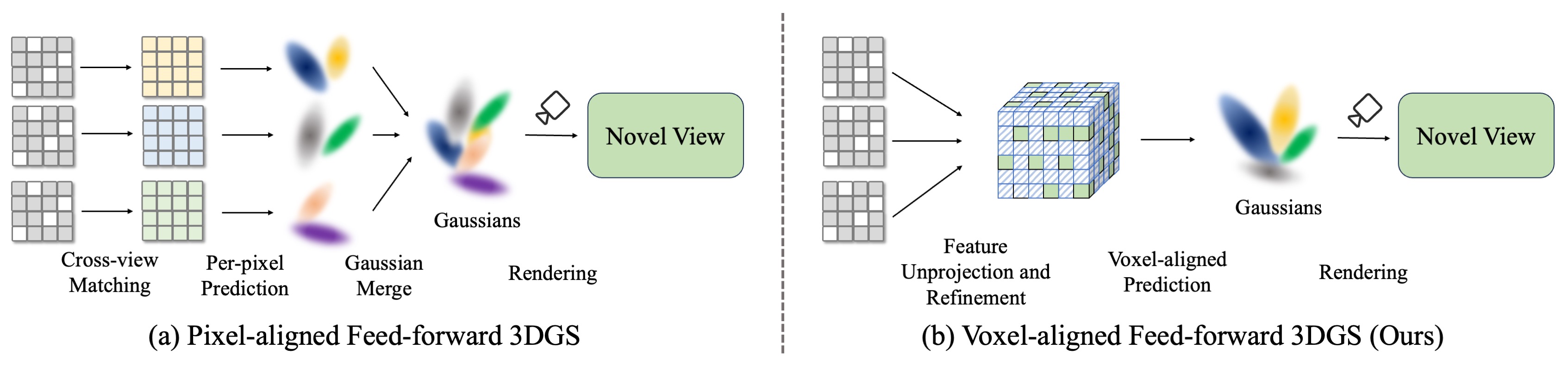
Pixel-aligned feed-forward 3DGS methods suffer from two primary limitations: 1) 2D feature matching struggles to effectively resolve the multi-view alignment problem, and 2) the Gaussian density is constrained and cannot be adaptively controlled according to scene complexity. We propose VolSplat, a method that directly regresses Gaussians from 3D features based on a voxel-aligned prediction strategy. This approach achieves adaptive control over scene complexity and resolves the multi-view alignment challenge.
-
2025-12-21 Update: Release our training/evaluation code and model checkpoints. We are working on a more powerful version of VolSplat. Stay tuned!
-
2025-09-23 Update: Release our paper on arXiv.
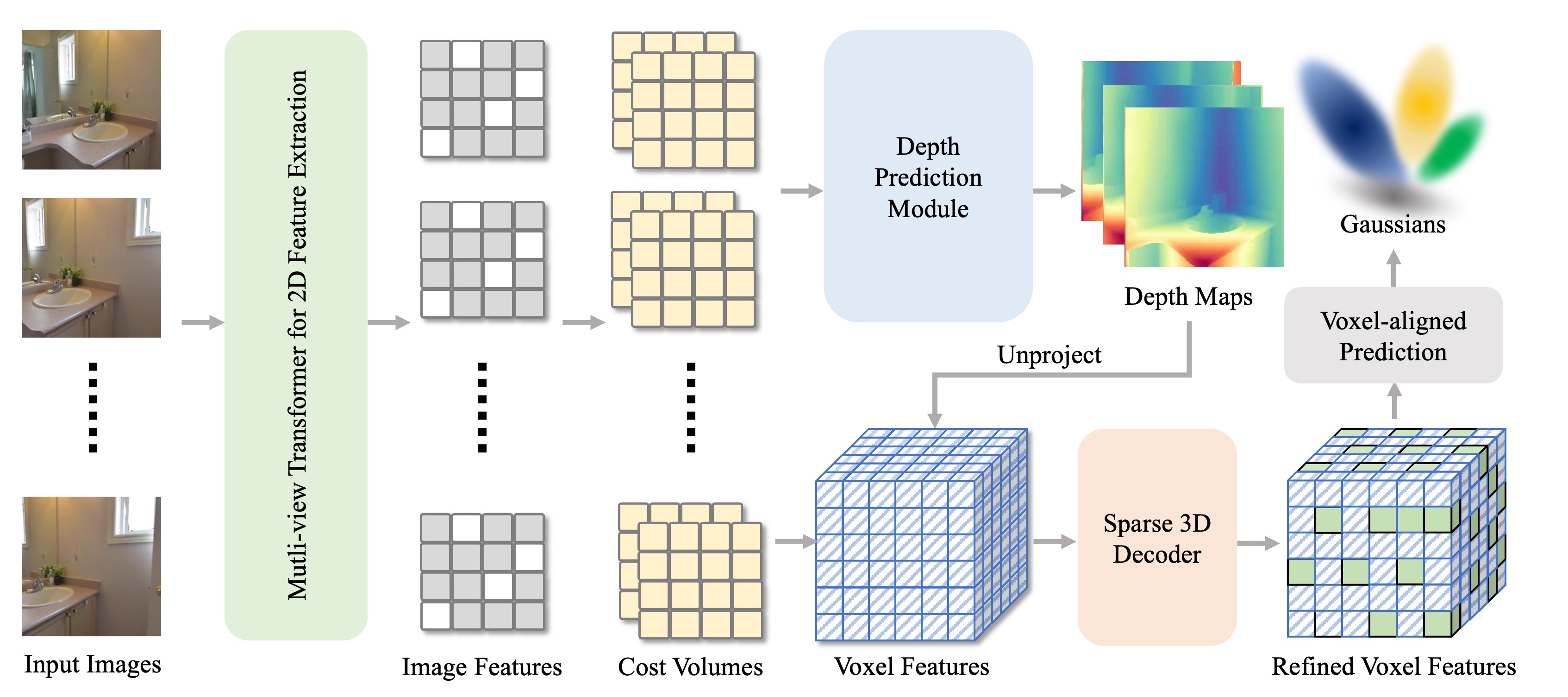
Overview of VolSplat. Given multi-view images as input, we first extract 2D features for each image using a Transformer-based network and construct per-view cost volumes with plane sweeping. Depth Prediction Module then estimates a depth map for each view, which is used to unproject the 2D features into 3D space to form a voxel feature grid. Subsequently, we employ a sparse 3D decoder to refine these features in 3D space and predict the parameters of a 3D Gaussian for each occupied voxel. Finally, novel views are rendered from the predicted 3D Gaussians.
Our code is developed and tested with PyTorch 2.4.0, CUDA 12.1, and Python 3.10.
conda create -n volsplat python=3.10
conda activate volsplat

pip install torch==2.4.0 torchvision==0.19.0 torchaudio==2.4.0 xformers==0.0.27.post2 --index-url https://download.pytorch.org/whl/cu121
pip install -r requirements.txt

# Install MinkowskiEngine
# For easier installation, we made some modifications based on https://github.com/Julie-tang00/Common-envs-issues/blob/main/Cuda12-MinkowskiEngine and included it directly in our project.
conda install -c conda-forge openblas
pip install ninja
cd MinkowskiEngine
python setup.py install
cd ..Our pre-trained models and baseline models are hosted on Hugging Face. Please download the required models to the ./models directory. To facilitate reproduction and comparison, we also provide pretrained weights from the baseline methods trained using same input views.
| Model | Download |
|---|---|
| volsplat-re10k-256x256 | download |
| pixelsplat-re10k-baseline-256x256 | download |
| mvsplat-re10k-baseline-256x256 | download |
| transplat-re10k-baseline-256x256 | download |
| depthsplat-re10k-baseline-256x256 | download |
| ggn-re10k-baseline-256x256 | download |
Please refer to ZPressor for dataset format and preprocessed versions of the datasets.
For Scannet, we follow FreeSplat to train and evaluate on the 256x256 resolution.
Before training, you need to download the pre-trained UniMatch and Depth Anything V2 weights
wget https://s3.eu-central-1.amazonaws.com/avg-projects/unimatch/pretrained/gmflow-scale1-things-e9887eda.pth -P pretrained
wget https://huggingface.co/depth-anything/Depth-Anything-V2-Base/resolve/main/depth_anything_v2_vitb.pth -P pretrained
Run the following command to train on RealEstate10K:
python -m src.main +experiment=re10k \
data_loader.train.batch_size=1 \
'dataset.roots'='["datasets/re10k"]' \
dataset.test_chunk_interval=10 \
dataset.num_context_views=6 \
trainer.max_steps=150000 \
model.encoder.num_scales=2 \
model.encoder.upsample_factor=2 \
model.encoder.lowest_feature_resolution=4 \
model.encoder.monodepth_vit_type=vitb \
output_dir=outputs/re10k-256x256 \
wandb.project=VolSplat \
checkpointing.pretrained_monodepth=pretrained/pretrained_weights/depth_anything_v2_vitb.pth \
checkpointing.pretrained_mvdepth=pretrained/pretrained_weights/gmflow-scale1-things-e9887eda.pthTo train on ScanNet, we fine-tune the model pre-trained on RealEstate10K.
python -m src.main +experiment=scannet \
data_loader.train.batch_size=1 \
'dataset.roots'='["datasets/scannet"]' \
dataset.image_shape=[256,256] \
trainer.max_steps=100000 \
trainer.val_check_interval=0.9 \
train.eval_model_every_n_val=40 \
checkpointing.every_n_train_steps=2000 \
model.encoder.num_scales=2 \
model.encoder.upsample_factor=2 \
model.encoder.lowest_feature_resolution=4 \
model.encoder.monodepth_vit_type=vitb \
output_dir=outputs/scannet-256x256 \
wandb.project=VolSplat \
checkpointing.pretrained_model=models/volsplat-re10k-256x256.ckptEnsure pre-trained or downloaded models are located in /models.
python -m src.main +experiment=re10k \
data_loader.train.batch_size=1 \
'dataset.roots'='["datasets/re10k"]' \
dataset.test_chunk_interval=10 \
dataset/view_sampler=evaluation \
dataset.view_sampler.num_context_views=6 \
dataset.view_sampler.index_path=assets/re10k_evaluation/evaluation_index_re10k.json \
trainer.max_steps=150000 \
model.encoder.num_scales=2 \
model.encoder.upsample_factor=2 \
model.encoder.lowest_feature_resolution=4 \
model.encoder.monodepth_vit_type=vitb \
mode=test \
test.save_video=false \
test.save_depth_concat_img=false \
test.save_image=false \
test.save_gt_image=false \
test.save_input_images=false \
test.save_video=false \
test.save_gaussian=false \
checkpointing.pretrained_model=models/volsplat-re10k-256x256.ckpt \
output_dir=outputs/volsplat-re10k-256x256-testWe use the model trained on RealEstate10K (zero-shot) to evaluate on ACID.
python -m src.main +experiment=acid \
data_loader.train.batch_size=1 \
'dataset.roots'='["datasets/acid"]' \
dataset.test_chunk_interval=10 \
dataset/view_sampler=evaluation \
dataset.view_sampler.num_context_views=6 \
dataset.view_sampler.index_path=assets/acid_evaluation/evaluation_index_acid.json \
trainer.max_steps=150000 \
model.encoder.num_scales=2 \
model.encoder.upsample_factor=2 \
model.encoder.lowest_feature_resolution=4 \
model.encoder.monodepth_vit_type=vitb \
mode=test \
test.save_video=false \
test.save_depth_concat_img=false \
test.save_image=false \
test.save_gt_image=false \
test.save_input_images=false \
test.save_video=false \
test.save_gaussian=false \
checkpointing.pretrained_model=models/volsplat-re10k-256x256.ckpt \
output_dir=outputs/volsplat-acid-256x256-testIf you find our work useful for your research, please consider citing us:
@article{wang2025volsplat,
  title={VolSplat: Rethinking Feed-Forward 3D Gaussian Splatting with Voxel-Aligned Prediction},
  author={Wang, Weijie and Chen, Yeqing and Zhang, Zeyu and Liu, Hengyu and Wang, Haoxiao and Feng, Zhiyuan and Qin, Wenkang and Zhu, Zheng and Chen, Donny Y. and Zhuang, Bohan},
  journal={arXiv preprint arXiv:2509.19297},
  year={2025}
}If you have any questions, please create an issue on this repository or contact at wangweijie@zju.edu.cn.
This project is developed with DepthSplat and MinkowskiEngine. We thank the original authors for their excellent work.